Sunday, March 25, 2012

Young and Restless: My Adopted Baby… Bird

I didn’t imagine taking care of a young wild bird. First, I think I will be reprimanded by the government or by my club. Two, I’m not equipped and it might end up dead in my custody. And three, I don’t want to be hassled.

But last March 23, when we were about to eat dinner, Mom called me from our front door. She saw something inside a pail. I hurried to the door and tried to see what it is. We initially thought that it was a frog but I concluded that it’s a young pied fantail. Good thing that the pail is empty because normally it is filled with water.

Mom told me that there’s a spider on the side of the pail. I readily felt something crawling on my fingers so I dropped the pale. Yes? You’re right. The bird is still inside in the pail. The bird managed to survive the drop. I didn’t want to hold the bird for fear that its parents won’t return to it. But I had no choice. I wanted the bird to survive.

I took a rug and placed the bird on it because it’s sopping wet. I suspected that the bird was attacked by big red ants and it fell because there were ants still biting it. I thought of making an improvised nest so I used a sombrero. I put some dried leaves and placed the bird on it.

It is already skittish. It flew from the sombrero several times so I placed another sombrero (salakot) on top of it to keep inside. I was happy that it’s lively for I thought that it will have more chances to survive. I also consulted my books if there some information about young pied fantails and I also texted my birdwatcher friend Jops.

I have it placed beside my bed for fear that rodents will attack it.

March 24, I planned to stay long on my bed but I have an “adopted baby” to take care for. Talk about the hassle! I placed the sombrero outside Mom’s garden. The young bird flew. It went to a small papaya tree. I was glad that its parents went to feed it. What a relief! I really feared that its parents will not return to it because I held it several times.

I have to intervene again because the papaya tree is located in a shaded area. I wanted the young bird to receive the energy from the sun. Yeah, I’m thinking about Superman. I also transferred the young bird because the papaya tree is near where the cats hang around. The parents have been busy warding the cats away and they can’t concentrate on feeding their young.


I placed the young pied fantail back to the sombrero and placed the sombrero on top of Mom’s orchids, which is much nearer the original nest. However, the young bird is really restless. It flew again. It went to the star apple tree and then it flew to our wall about 10 feet high. Its claws managed to hold on to the rough wall but it fell! To my dismay! How can I leave this young bird if this is its behaviour?


It fell at the bottom of Mom’s plants. I have to hold the bird again to catch it. I put it back inside the sombrero and placed the sombrero on top of the orchids. Thankfully it stayed there for several hours. The parents were able to feed it and I was able to document the activity.


I thought I could now let go of the young bird. But it rained so hard in the afternoon! I took the improvised nest and placed it on top of Mom’s plants by our front door. The parents still fed and protected the young bird.

I was already confident that nothing bad will happen with the young bird. I was already busy doing my own thing. It was almost evening when I checked the young bird and to my horror I saw the bird drowned in a pail of water. I quickly scooped the bird with my hand. It reacted to my touch so I was hopeful to revive it. My brother Paul and I hurried to dry the feathers with a blower. It became active again after its feathers dried up. To my relief! I placed the bird beside the exhaust of my CPU because it is warm. But it flew to the floor. I almost stepped on it! Grrrr!

This time, Mom suggested placing the bird inside a bird cage. I complied with a heavy heart. I hope my wild bird watching club and photography group will extend their forgiveness to me for caging a wild bird. I just wanted the bird to survive. I was thinking that I could at least extend the bird’s life by keeping it from falling and drowning.

March 25, I wasn’t able to go to church. I had a terrible slipped disk pain attack again. Before having the bird placed outside to be fed by its parents, I have its right eye gently wiped with a damped cotton swab because it closed due to some irritation due to the drowning incident.

With the help of my Mom and my brother Paul, the cage was hung on the atis tree’s branch. We left the cage’s door open. The pied fantail parents still fed and defended their young. They even attacked us several times. Talk about gratitude!


I just stayed inside our house. The slipped disk pain is quite unbearable. But I managed to take some shots to document my unusual experience. But something happened to my photography gear this day. Something heartbreaking! That’s another story perhaps.

The young bird fell again! Maybe I should let it die for its restless adventurism. I deemed that there’s already so much human intervention for it to survive. Taking care of the bird may cost me another thing or two. But I secured the safety of the bird by caging it again. I can’t help it. I was quite certain that its parents will provide it with food even if it’s caged.

Why am I hassling myself for fairly common bird? It’s not even an endangered species. I could let the young pied fantail be and whatever happens to it would seem negligible. I would wake up the next morning and able to see another of its kind. I’ve been wondering too how can taking care of a young wild bird be a God-glorifying activity (1 Corinthians 10:31)?

In Genesis 1:28-30, God commanded man to have dominion over His creation. Dominion means God has allowed man to be a servant or steward of His creation so that it will be replenished. Birds were particularly mentioned, by the way. In this day and age, people are dominating God’s creation in a way that leads to its destruction and not its replenishment. Perhaps even with one bird I could make a difference. Perhaps my simple act would encourage my relatives and my neighbours to be mindful of God’s creation.

Wednesday, March 7, 2012

Certified Birdnut

Last Monday, the recommendation that I become a Certified Birdnut was approved. I was recommended by Kuya Bob Kaufman and the approval was made by Romy Ocon himself, the Philippine premier bird photographer.


I was so elated. It’s like I’m dreaming when I was reading the thread in the Philippine Bird Photography Forum where I belong but it’s true. I’m now a Certified Birdnut!

The approval of Ka Mastah Romy is really something. We haven’t met personally but we have one exchange of e-mails. I have high respect for Ka Mastah because he really excelled in wild bird photography, even if he is color blind, and because of his humility.


But I’m more amazed with the words used by Kuya Bob when he recommended me. He said, “I can vouch for his integrity.” Those are heavy words! He would put his name at stake for recommending me. “Integrity” is a loaded word in itself. I don’t know the intent of his word but, for someone like me who works with finances, it means honesty, truthfulness and reliability. Perhaps in bird photography it means I do my assignment, I don’t cheat my photos or I respect other photographers/birders and the subject of our photography.


I’m honoured and humbled to be considered a person with integrity but it also entails responsibility. I have to uphold the recognition. I’m thankful to God for this “achievement.” It’s really an honour to be in the league of great wild bird photographers. I’m thankful to the Lord because it is only by His grace that I could produce some good bird images. I’m thankful that He gave me the opportunities, for the skills and for PBPF who inspired me and taught me not to settle for mediocrity.

So, yes, like what I mentioned in my previous blog, bird photography is indeed madness. Being a birdnut means that we are really crazy for our Philippine avian treasures. Being a birdnut means we would go great lengths to photograph birds. We will hike mountains. We will wade rivers, streams and the beaches. We will risk being attacked by insects, snakes, wild animal or hostile individuals. We will crawl the ground. It could be madness but I would say it is passion!

Tuesday, March 6, 2012

PEO-troglyphs

The Philippine Eagle-Owl (Bubo philippensis) belongs to vulnerable species of birds. It is endemic to the Philippines. Little is known about the behavior of this secretive species. Thus when sighting of this bird circulated in our organization, it has become an instant celebrity. Our first sighting is inside the MWSS compound. The second is in Angono-Binangonan Petroglyphs.

The Angono-Binangonan Petroglyphs, by the way, is the oldest known work of art in the Philippines. These inscriptions clearly show stylized human figures, frogs and lizards along with other designs that may have depicted other interesting figures but erosion may have caused it to become indistinguishable. Although it sits along the boundaries of Angono, Binangonan and Antipolo of the province of Rizal, this heritage site was discovered by the late National Artist of the Philippines awardee Carlos “Botong” V. Francisco in 1965. Since then, some rock carvings have been damaged due to neglect and vandalism. In 1973, by virtue of Presidential Decree No. 260, it was declared as a national cultural treasure by the Philippine government. During that time, a team led by the National Museum of the Philippines started archaeological site conservation and site development of the petroglyphs in which a mini-museum, view deck and stone path among others were constructed.

Since I’m a birder and a fan of archeological treasures, I planned to go visit the place even if the place is quite far for commute. God, however, provided a free ride courtesy of fellow bird photographer Kuya Bob Kaufman. We went to the petroglyphs site with Kuya Jun Osano.

PEO is the abbreviated name for the largest owl of the Philippines and petrogylphs, also called rock engravings, are pictogram and logogram images created by removing part of a rock surface by incising, picking, carving and abrading. Thus I coined the Philippine Eagle-Owl photographed in Angono-Binangonan Petroglyphs as PEO-troglyphs.

The female adult...

 The juvenile...

 I wonder if this is how it'll look like if they have some kind of eye problem...


 A wink from an owl...

Showing how big his/her foot is...

Peek-a-boo!

The petroglyphs...


Mini-museum...


So I invite you to see our own national treasure!

Wednesday, February 29, 2012

Wild Bird Photography

A lot of my friends are asking why I do bird photography. I have to qualify though that the birds I photograph are those in the wild, meaning they are not caged. I don’t really fancy myself with birds in captivity. So, why do I do wild bird photography? My ready answer is that they are fascinating creatures that God created and birds always reminds me of God’s faithfulness and grace in my life. A pretty “spiritual” answer but is it enough reason then to “justify” this madness and the reason to acquire expensive gears and accessories.

Here’s my situation. I work in a missionary organization receiving a meager salary that is just enough to support myself, my parents, siblings and nephew. With the unstoppable rising cost of living, supporting them with my salary seems to be not enough now to make ends meet. So why pursue a field of photography that is quite costly?

First, as I’ve mentioned earlier, this is some kind of madness. As Toto Gamboa wrote in his blog, “As one bird photographer friend said, wild bird photography is like being a toy or comics collector. You just want to have all of them. There is some kind of addiction that you will develop when you dip yourself into it. So beware.”

Second, I really love nature and the outdoors. I grew up watching Disney movies that portrays wild animals that can petted. I also remember growing up with the Tarzan series. I also imagine myself flying a lot of times. So birds in the wild are really appealing to me.

Third, wild birds also come with different plumage and behaviors. Thus they are graphically and visually appealing to the eyes. Honestly, I have this “fear” that I might end up like my father, who is now blind due to retinal detachment. So I have this urge to see as much of the beautiful things the Lord has created while I have my sight. Of course, I pray hard that I will not end up blind.

Fourth, wild bird photography is unlike other field. I think it is more challenging compared to doing portrait, landscape or food photography wherein the photographer can have the guarantee in controlling photographic situation. Unlike models whom you can direct to do a particular pose, birds do a lot of movements. “There is always an ingredient of unpredictability,” as Toto Gamboa puts it. Wild bird photography requires a lot of patience and study to achieve a good photograph.

Fifth, I believe that not everyone can do wild bird photography. There are more than 30,000 amateur and professionals photographers in the Philippines. But there are only a number of photographers who pursues wild bird photography. I can do other photography but I’m more passionate in developing my craft with wild birds.

But that passion comes with frustrating fact that I can’t afford expensive gears. I didn’t plan to do wild bird photography when I bought first DSLR. Now I’m quite stuck with my one and only Nikon D5000 DSLR camera. It only has 12.4 mega-pixels (MP) and can shoot up to 4 frames per second (FPS) [according to the manual]. However, 12.4 MP is fine but with very small birds, like sunbirds, gerygones or tailorbirds, I don’t have the liberty to crop to zoom in to the subject. Most, if not all, of my fellow bird photographers are using Canon. Even Canon entry level DSLRs have up to 18 MP to boast.

D5000 says that it can do 4 FPS but in my actual use for bird photography it can only do 2-3 FPS. D5000 has 11 focus points but only 1 cross-type AF point located in the middle. I just don’t know if the Canon equivalent of D5000 has more cross-type sensors.

In my experience, having 12.4 MP and 4 FPS is not enough because I don’t see a lot of feather details in my photographs. I have a number of good bird photos but majority of the time it seems that I just wasted a lot of shots. My verdict is that D5000 is not recommendable if you intend to do take great bird images.

Coupled with the camera should be a good telephoto lens. I initially bought a Nikkor 70-300mm G lens. It’s very cheap that is why I bought it. However, it doesn’t have its own motor and it doesn’t auto-focus with my camera. It was okay then because I was just testing if I will really like photographing subjects from afar. It was really, really hard doing manual focusing with bird photography. I think the only bird I shot with the 70-300mm that has good quality is the pygmy woodpecker.

My frustration with blurred images and missing a lot of photographic opportunities led me to seek a better functioning lens. At that time, I learned that my camera is a grey item and the rest of my Nikkor lenses are grey. Thus having Columbia Digital, Nikon’s authorized distributor in the Philippines, support was quite difficult and expensive. Bird photography becomes even more frustrating on my part. I learned that there are good a third-party lenses from Sigma. I leaned toward Sigma because the premier wild bird photographer Romy Ocon used Sigma before he became a Canon Ambassador.

I tried to find a lens that can auto-focus with my D5000, one that has optical stabilization system when handheld, one that I can carry for a long period time because I have slipped disk problem and one that I can purchase using my life savings. I ended up with the Sigma APO 150-500mm. It has good reviews and some fellow bird photographers have used it in the field.

In actual use, the Sigma APO 150-500mm is quite a good and sharp lens. The auto-focus is fast even in poor lighting condition. Plus I have a good experience with JT Photoworld in terms of after sales service.

The next crucial accessory is the tripod. I bought a P1,700 worth of China brand tripod before I even got into bird photography. When I acquired my Sigma lens, it can no longer support my system. I have a lot of wasted shots also because of poor ground support. That cheap tripod tends to wobble in acute angle positions. Then, I managed to acquire a Benro Travel Angel tripod and it’s a pretty good support system.

My bird photography has changed and improved quite well because of my current system. I tried to get more familiar with the features of my camera and lens. But the more I get to know my gear, the more I get to know its limitations.

I’m struggling how D5000 handles high ISO. Noise becomes quite evident even at ISO-800. It performs very poorly when I shoot under canopies, where small birds would often be found. The FPS is not sufficient. Since D5000 is an entry level DSLR, a lot of the settings are hidden in the Menu. In my experience, some shots are missed because adjustments that could have been done through separate buttons or dials but I would have to go through the Menu. D5000 exposure indicator tends to be misleading also resulting to undesired exposure.

I’m struggling now regarding the “future” of my bird photography. I’m thinking of, at least, getting a Nikon D7000. But that would mean breaking the bank or selling one of my kidneys. If I saved three years for my D5000, then imagine how long will I save for a D7000, which is almost twice the price of my D5000. I’m also thinking of shifting to Canon but I invested so much for a Nikon system, even if some of them are grey items. I envy fellow bird photographers who seem to be getting better bird images because of their Canon system. But then in my own perception, images taken using Nikon are quite better. I also have this personal goal to prove that Nikon can produce equally great, if not better images than that of Canon.

When will that happen? I don’t know. Unless I earn bigger (which is quite a remote possibility with my current employment)… or unless I steal (which is a sin), I don’t know. For the meantime, I’ll try to enjoy what I have, pray that I have a good shooting opportunity and pray that God will provide me my dream wild bird photography system.

Wednesday, February 22, 2012

What Can We Learn From Quails?

I haven’t seen any quails yet in the wild. I have seen beautiful photos of wild quails. My experiences with quails are just those peddled in the market or school and that of eating quail eggs peddled by vendors when you’re traveling to the provinces. But there’s an interesting lesson that I just learned yesterday in my Bible reading. I encountered quails in Numbers 11.


Human beings are hardwired discontented creatures. Contentment is something that should be learned. It is something acquired. It is not served in a silver platter. That is why the Apostle Paul said, “I have learned to be content whatever the circumstances (Philippians 4:11).”

The Israelites of the Old Testament were a bunch grumbling folks. In Numbers 11:4-6, they were craving and complaining for meat. They were too tired to eat manna. They were too fed up to taste another meal made out of manna. If they were Filipinos, they would have said, “Manna na naman!”

The attitudes of the Israelites had the Lord exceedingly angry and had Moses deeply troubled (Numbers 11:10). After praying, God told Moses that he will give what the people want. Moses declared to the people, “Now the LORD will give you meat, and you will eat it. You will not eat it for just one day, or two days, or five, ten or twenty days, but for a whole month—until it comes out of your nostrils and you loathe it—because you have rejected the LORD, who is among you (vs. 18-20).”

Moses, however, wondered how can 600,000 men on foot be provided with meat. In verse 23, the LORD answered Moses, “Is the Lord’s arm too short? Now you will see whether or not what I say will come true for you.”

In the succeeding verse, a wind went out from the Lord and drove quail in from the sea. The quails are scattered up to almost 36 inches deep all around the camp. For about 48 hours, the people went out and gathered quails. No one gathered less than 2,200 liters. Seems to be real good news BUT “while the meat was still between their teeth and before it could be consumed, the anger of the LORD burned against the people, and he struck them with a severe plague (vs. 33).” Those who had craved other food were buried by the people who were spared from the plague.

What’s my personal insight in Numbers 11? First of all, my insights are based on my observation of what is simply indicated in Scripture.

1. God is already actively providing food for the Israelites and yet they complained that it wasn’t enough and satisfying.

2. God, in His infinite wisdom, knows exactly what we need at a given time. Even if we desire something and keep on praying for it, it may not be right for us to have that thing or the thing is right for us but it is not yet the right time.

3. This leads me to the third point. A blessing can turn into a curse or something that will destroy us. There seems to be nothing wrong with meat cravings but the attitude of the people mattered. They were ungrateful and full of discontentment. Even if God was there in their midst, His presence was less of a concern. If satisfying the appetite is more important to you then there’s something wrong. Further, upon seeing the abundance of quails, the people in their greed hoarded. Each individual took more than what they need. Imagine taking more 2,200 liters of meat for yourself. No wonder God was so angry with them.

4. What we desire can be idols in our heart and God abhors idolatry. Idols are not just those tangible sculptural works. These could be anything that displaces God in our hearts. In the case of the Israelites, it is food. They made a god out of their appetites. Work, hobby, family can be or can become idols if they become first and foremost in our lives.

So the next time you see a quail or even its egg, at least, ask yourself if you are grateful for everything that you receive from the Lord.

Monday, February 6, 2012

The Bird With The Waggley Tail

I was doing my daily routine of looking through our jalousies while preparing for office this morning when I saw an “unusual” bird on our neighbor’s roof. I was actually looking for the Eurasian tree sparrows. I’m trying to confirm my observations with the Robson’s field guide regarding the plumages of the male, female and breeding male.

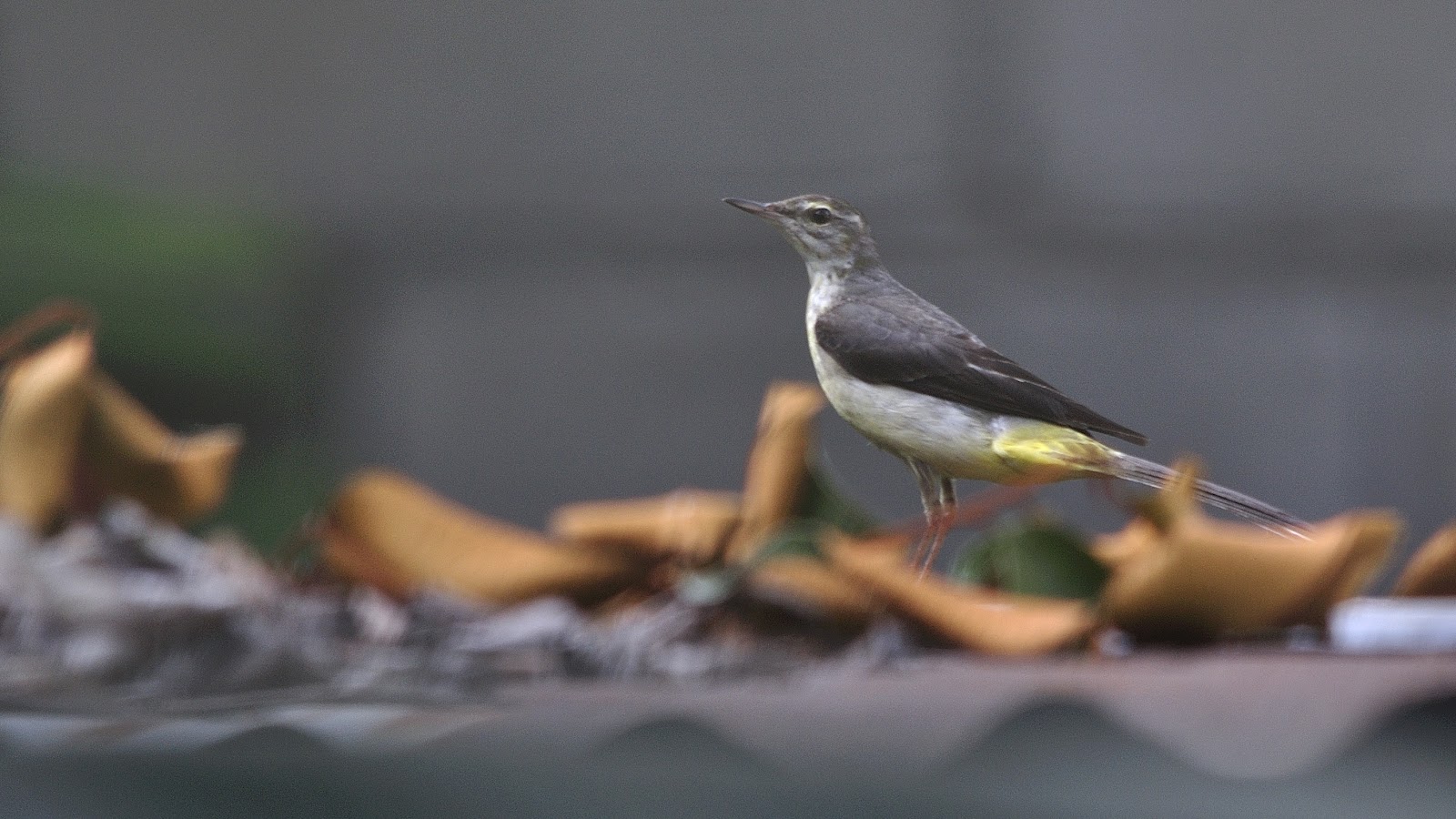
But my attention was drawn to a solitary bird with the “waggley” tail. I don’t know if the use of term is apt but the point is the tail is wagging. The bird has a slenderer body compared to the resident birds. Even for a short distance, I noticed that the flight pattern is also different.  “Man, this not the usual fantail or bulbul that I see every morning,” I told myself. So I took my binoculars and try to look where it went. It went to the other part of the roof of our neighbor near the miry creek. My suspicion was correct it is a wagtail!

Instead of observing it more carefully to confirm the specific species, I went down to our dining area and called my mom and brother. I wanted them to see the bird as well. But the bird flew away. While they were waiting for the bird to come, I readied my camera to document the sighting. For me, it’s really unusual, if not rare, for a wagtail to visit our place. I planned before of going to Laguna just to see a grey wagtail. And then when the white and grey wagtails visited the La Mesa Dam spillway, a longer trip is no longer necessary. But seeing a wagtail, 20 feet away from me is another thing!

It went back and I was able to make two shots. It's confirmed! It's a grey wagtail! The photos are okay but not that sharp because of the jalousies and I’m anxious about getting late for work. I waited for a few more minutes, hoping that it will show up again but I really have to leave for work. Oh, why is it always this way!


I went to work quite happy even if I will have deduction for coming in late. I have a new Bagbag, Novaliches record! But then I was also worried because the bird forages in the lot where the bird hunter lives. 

For my non-birding readers: 

Behavior: found in open country along stream and rivers, also creeks in forest and built-up areas, feeds on the ground, flies with undulating pattern, flying low up the stream when flushed and vigorously wagging its tail when landing, walking or when perched. 

Identifying Marks: medium-sized (18-19 cm), white eye stripe, grey mantle, white wing-bar, yellow-green rump, longer tail than that of a yellow wagtail, bright yellow vent, the underparts are yellow and the throat is white in winter (black when breeding). 

References: A Photographic Guide to Birds of the Philippines by Tim Fisher 
A Guide to the Birds of the Philippines by Robert S. Kennedy, et al 
A Field Guide to the Birds of South-East Asia by Craig Robson

Sunday, February 5, 2012

The Big Year Movie: My Review

I watched “The Big Year” with my family a few nights ago. It interests me because I’m into bird watching. It’s a comedy film but I was more amazed with the birds I saw in the film than be entertained with the comic acts of the actors. Talk about bird watching in the movie. Well, I actually do that, since I don’t have much time to go to the field.

I did some research if there’s indeed a thing called “Big Year.” According to Wikipedia, a “Big Year is an informal competition among birders to see who can see or hear the largest number of species of birds within a single calendar year and within a specific geographical area.”

The movie is humorous but there is a wealth of lesson that can be learned by watching the film. Jack Black (as Brad Harris), Owen Wilson (as Kenny Bostick) and Steve Martin (as Stu Preissler) starred the movie.

Characters (to give some context)

Kenny Bostick is reputed to be the best birder in the world because he holds the record of seeing 732 birds in one calendar year. Now some birders like Brad Harris and Stu Preissler are also doing a Big Year.

Brad Harris is a fulltime employee who dreams of topping Bostick’s records. He’s very good with bird calls. Problem is that he doesn’t have the luxury of time and resources to do a Big Year. He even borrows money from his dad to fulfill his dream. At one point he maxed out the credit cards that he have. Imagine spending more or less $10,000 just to see more than 732 bird species in a year!

Stu Preissler is a businessman who plans on retiring and wants to spend his first year of retirement doing a Big Year.

There are birding practices depicted here that are not advisable if you really want to enjoy this activity. One, Bostick often wears bright colored clothes and he is always on the run or he is running doing the activity. I was advised to wear earth color clothes and to walk slowly when I bird. Two, once he spots the bird, that’s it! No appreciation of details or sorts. Well, it’s a Big Year and it is a race! Three, there are occasions also that he puts down other birders.

Lessons (highlights)

I guess you have to be spiritually keen to see the problem of pride, especially in the character of Bostick. He doesn’t want anyone to beat his record. He will compromise or give up time with his wife who is so desperate to build a family. He will put down others. He will rather spend Thanksgiving or Christmas Eve alone to find a bird than spend time with a love one. By the way, he is called the “birding machine.”

You could be able to do amazing feats but not at the expense of family. This is the amazing thing with Harris and Preissler. Harris still goes home even if his dad doesn’t approve of his hobby. He went to hospital when his dad had a heart attack. He still persisted to show to his dad that his hobby is not a waste of time. At the end, his dad joined him to see the great grey owl and it’s his dad who spotted the bird. Preissler went home to see his grandchild and said that it’s his rare find.

Friendship is also valuable treasure to earn. You may have the largest list of seen bird in the world but if you don’t have someone to share it with then I think it’s useless.

Honesty. I have seen in the film that one can come up with a list and say that he saw or heard them all. But truth is that he could have cheated somewhere in the quest. If I remember it right, the main code of conduct is “Honor and Decency.”

Passion. Although for the case of Bostick it’s quite on a negative side, I would say that the three have passion for their hobby, which is birding. No matter how extravagant or illogical their goals are in seeing the most birds, goals or dreams are still worth pursuing. Passion also involves knowing the things you ought to know about your hobby. Harris listens to MP3 recordings of bird calls. One has to know bird behavior, what attracts birds, where do birds go during migration and fallouts.

I’m against the “drop-everything-and-do-what-you-want-to-do” attitude of Bostick. As a Christian, my priority is to enjoy God first and foremost and to love his church and to love my family. Anything that doesn’t rightly fall in these priorities becomes secondary. That is why I don’t bird on Sunday because it is the time I worship and serve the Lord with fellow saints.

I think I have written long enough about the movie. I might spoil it if you haven’t seen it yet. One last thing, it is also important to enjoy!

p.s.
There is an interesting review also that I saw in the web about the movie: http://www.pluggedin.com/videos/2012/q1/bigyear.aspx.